UX & UI Design
·
2025
Building a digital health locker for all medical files - Sehatra
Sehatra reduces the friction of carrying hospital files by giving every patient one calm, secure place for their records linked to their ABHA ID.
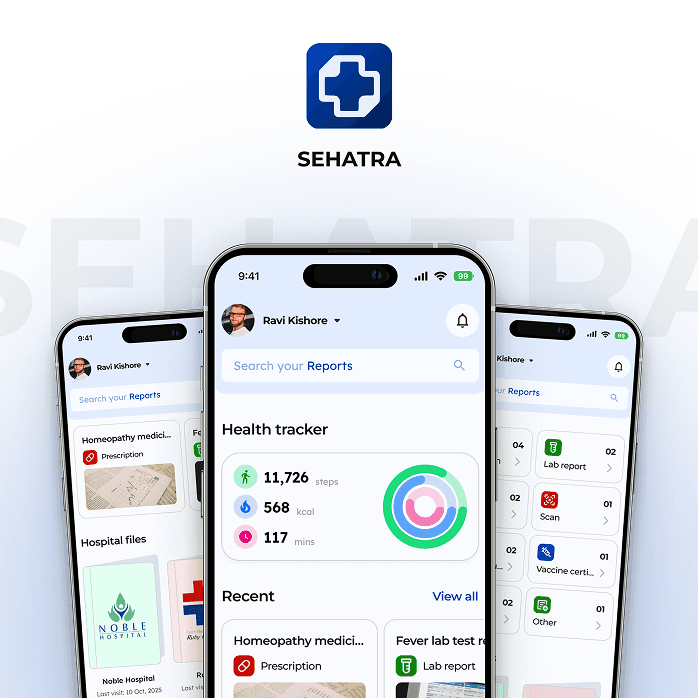
TL;DR
Even with official solutions like ABHA, medical records across India remain trapped in paper folders and disconnected hospital systems. I researched why current platforms fail patients, tested six concept directions, and put the strongest one through usability testing across seven flows, fixing two real failures before calling it done.
METHODS & STATS
Research, Wireframe, Business model canvas, High fidelity prototype, User testing
SAMPLE
48-response survey + interviews + 4-app competitive audit
KEY STAT
60.9% of respondents had never heard of ABHA
Testing
5 users, 7 flows, 2 real fixes shipped after failures
"Government itself does not know what to do with ABHA ID... it is only a 'Medical data collection tool'"
— a real participant quote
The process, at a glance
Four phases, not narrated in paragraphs
01
Discover
ABHA adoption data and user interviews.
02
Define
Onboarding, trust, and education, not tech, were the real barriers.
03
Design
QR sharing, ABHA linking, hospital-grouped records, consent-based access.
04
Validate
5-user moderated test on 7 flows, think-aloud, mobile prototype.
what already existed
A government system exists. Barely anyone trusts it yet.
Before speaking to a single user, national data pointed to a structural problem; India's healthcare system is still heavily paper-dependent, and that has a real cost.
80%
of patient records in India are still paper-based
1 in 3
patients lose or misplace medical files within a year — NHA survey
15–20%
of health insurance claims delayed or rejected over missing records
40%
of clinician time spent on paperwork instead of patients
I wasn't the first to tackle this. Four platforms already exist, but each has a specific gap preventing mainstream adoption.
Talking to the other side
The view from the frontlines
To see where the system breaks down internally, I ran semi-structured interviews with staff at hospitals across Pune and Ujjain. I needed to hear directly from the people managing the actual patient data and insurance workflows.
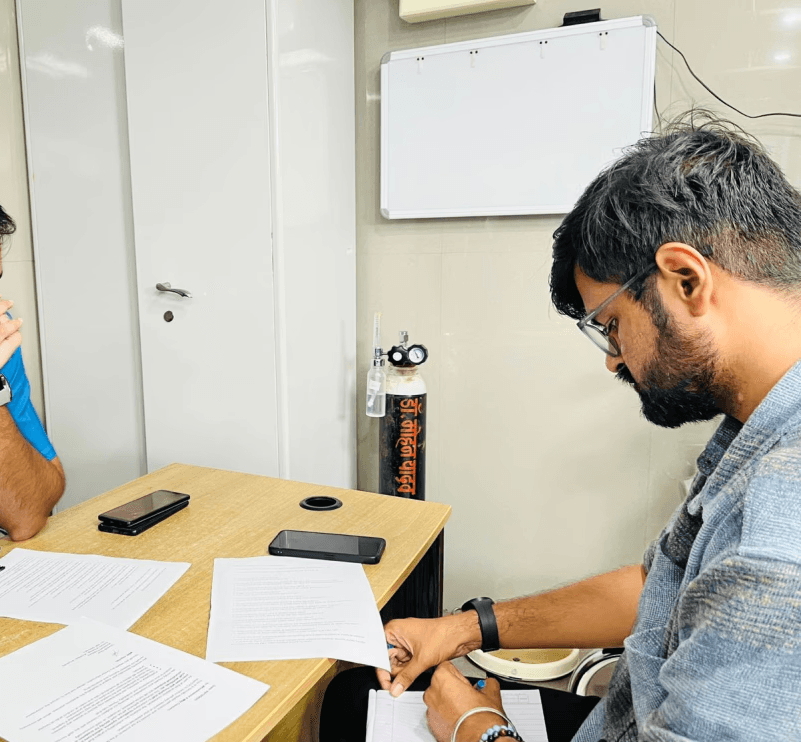
Semi-structured interviews · in-person & telephonic
Hospital staff confirmed very few patients had actually linked their ABHA ID with their medical records
Smaller clinics and diagnostic labs don't integrate with ABHA systems at all
Hospitals continue running manual or hybrid systems, leading to inconsistent record handling
"Patients have no idea about ABHA ID as patients are not familiar with it there is not much awareness around it." — hospital staff, Pune
A 48-patient survey proved the interview insights were real. These weren't isolated complaints, but the standard experience.
60.9%
haven't heard of ABHA
83%
still rely on physical files
58.7%
struggle to find or share reports
23%
faced insurance delays from missing docs
Turning the raw numbers and quotes into a single empathy map made an abstract statistic feel like an actual person.
Says
"It's so hard to find the right report before my appointment."
"I've heard of ABHA, but I'm not sure how to use it."
"I wish I had everything in one place."
THinks
"What if my medical data gets leaked?"
"I don't trust these apps with sensitive information."
"There should be a simpler way to manage all my documents."
DOES
Keeps physical files for reports and prescriptions
Stores PDFs in WhatsApp and phone gallery
Brings wrong or incomplete files to hospital visits
feels
Frustrated and anxious before appointments
Overwhelmed by paperwork and scattered data
Relieved when things are easy to find digitally
Bold claim first, evidence second
What the research actually said
Secondary research + empathy map
Platforms exist. Trust doesn't.
The technology is already built. India’s digital health infrastructure exist, what’s missing is the trust to adopt it.
Secondary research
Onboarding reads like paperwork
People aren't abandoning setup because they don't see the benefits. They leave because the onboarding process feels like filling out government paperwork.
Empathy map + secondary research
The system expects users to adapt
Existing tools are built for ideal conditions. They demand a level of digital fluency and calm that patients simply don't have when dealing with a medical issue.
Survey findings
Missing records cost real money
When records are scattered, insurance payouts fail. For patients, disorganized data has a direct financial cost.
problem statement
Numbers, market gaps, and user interviews all pointed in the same direction. Instead of assuming what needed fixing, I just followed where they all agreed.
Patients in India lack a unified and trustworthy system to manage their medical records. Health documents remain scattered across hospitals, clinics, and digital platforms, making access and sharing difficult. Although initiatives like ABHA and ABDM aim to streamline digital health, low awareness, inconsistent integration, and concerns about data privacy continue to hinder adoption.
IDEATION
Pulling the problem apart before reaching for solutions
Mind maps and 10-minute sprints. By favoring quantity over quality, I mapped out a massive range of raw directions before doing any actual filtering.


From the ideation came six raw concepts and I scored those concepts against user relevance, feasibility, and ABHA goals. Only the two strongest made the cut for wireframes.
Health Vault
Merged into final
A streamlined, intuitive place to store and find every record — answered the strongest research signal directly.
My Health Locker
Merged into final
Family-inclusive access, letting one account handle an entire household's records.
Other four directions
Cut before wireframes
Scored lower on feasibility or user relevance — either depended on hospital-side buy-in outside a student project's control, or treated a symptom rather than the root cause.
Instead of choosing just one, I merged them. By combining Health Vault’s record management with My Health Locker’s family accessibility, "Health Locker" was born; the concept that ultimately became Sehatra.
HEALth locker became sehatra
From insight to decision
INSIGHT
Onboarding reads like paperwork
PRINCIPLE
Setup should feel like unlocking value.
INSIGHT
Missing records cost real money
PRINCIPLE
Retrievable in seconds, not searched for.
INSIGHT
Platforms exist, trust doesn't
PRINCIPLE
Link ABHA early, building visible legitimacy
INSIGHT
System expects users to adapt
PRINCIPLE
Group records by hospital, not by file type
The core decisions
What those principles became
01
One unified locker
All records in a single ABHA-linked space, directly solving the clearest friction point found in research.
02
QR-based sharing
A fast, familiar handoff for records that need to move between patient and provider.
The solution, walked through
Four screens, each answering a specific insight
What testing broke
Five users, seven flows, two real failures
Before
3/5 users struggled

Share action buried in the header, access options stacked below the fold.
Proposed fix

Access type moved to the top, share action turned into a full-width primary button.
Before
2/5 users struggled

Visit history listed chronologically with no clear emphasis on the most recent entry.
Proposed fix

Most recent visit surfaced first, with clearer date hierarchy.
What improves
From scattered files to one trusted place
Faster onboarding
ABHA linking upfront removes the paperwork feeling that caused drop-off.
Faster sharing
QR handoff cut a multi-step process down to a single scan.
Faster retrieval
Hospital-grouped records match how patients actually recall history.
Fewer missed actions
Share and recent-visit fixes remove two confirmed points of friction.
See more projects