Field research
·
2026
Improving the darshan queue experience at Mahakal Temple
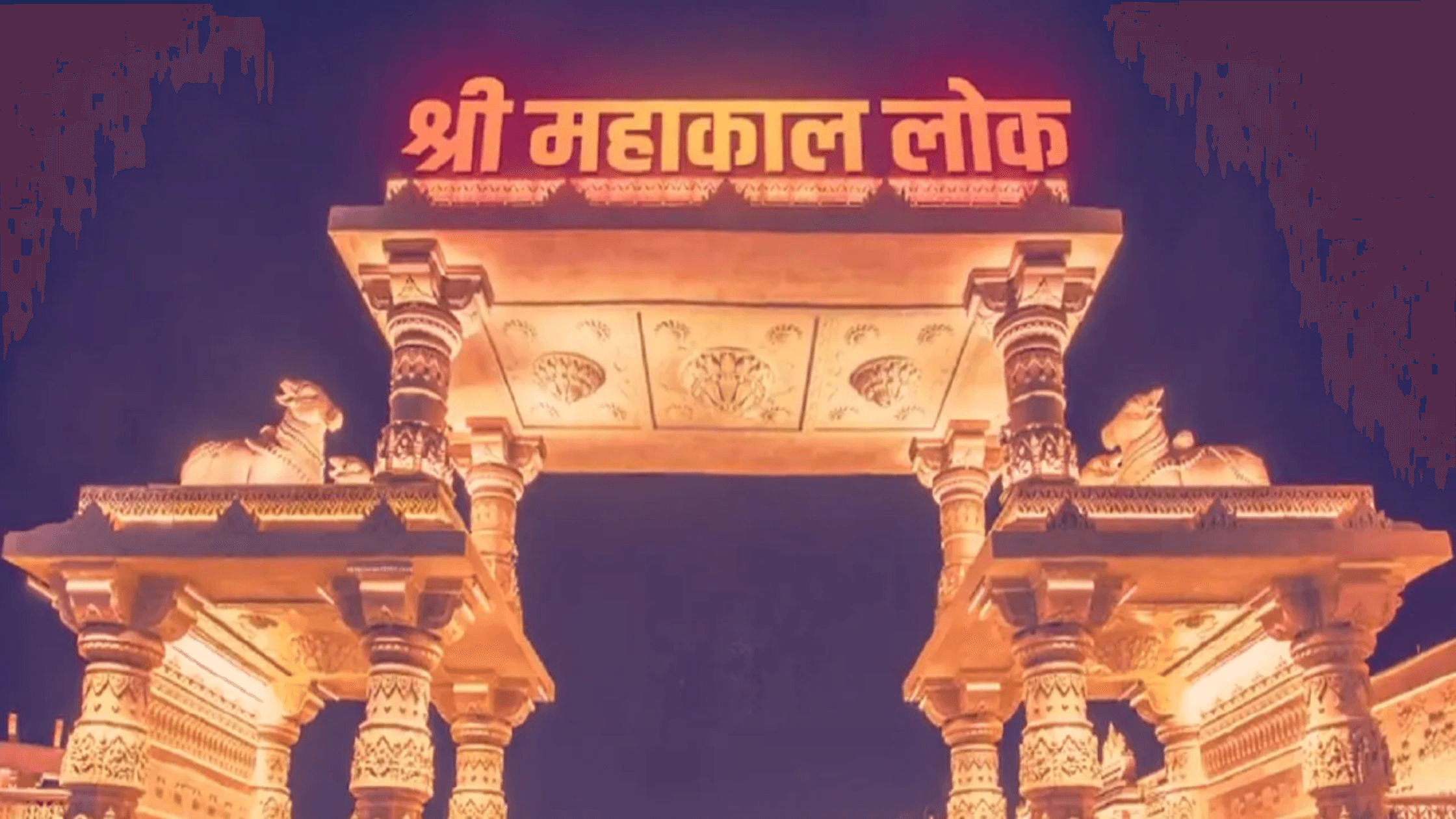
A field study on crowd flow, waiting anxiety, and operational clarity at one of India's busiest temples, Mahakaleshwar Jyotirlinga, Ujjain.
TL;DR
Devotees end up waiting far longer than they should because phone-deposit and darshan queues aren't connected well. This leads to extra delay, confusion, and real physical and mental stress. It all stems from one core problem: people get no clear information before joining a line. To solve this, I proposed four key changes: clear pre-entry phone deposit info, reorganized queue paths, real-time wait updates, and dedicated exit routing.
METHODS & STATS
User interview, Contextual Inquiry, Field Observation, Fly on the wall, Triangulation using survey, Affinity Mapping, Hypothesis mapping, Persona creation, Concept creation
SAMPLE
9 interviews + 11-response survey + 2 observation sessions
KEY STAT
91% of surveyed devotees experienced queue stoppages
OUTCOME
4 prioritized recommendations, scored on Desirability–Feasibility–Value
Thousands of devotees visit Mahakaleshwar daily. Watching that scale in person raised a question I didn't have an answer to yet: could an environment this dense and emotionally charged still have gaps no one had named?
"We waited 30 minutes just to deposit our phone."
a devotee, before they'd even reached the queue for darshan
Where it began
Discovering a problem, not choosing one
I started with only a location and zero assumptions about the user challenge. By analyzing 7 news articles on crowd control and 15 critical Google reviews, I focused first on discovering the right problem before trying to solve it.
1–2L
Daily footfall (up to 2 lakh on weekends/holidays)
1000+
Security guards deployed as crowd scaled
7
News articles reviewed on footfall, security, crowd control
15
One-star Google reviews analyzed for real devotee frustrations
Problem statement
Devotees struggle with long waiting times to complete darshan because inefficiencies across phone deposit lines and darshan queues create unnecessary delays, confusion, and physical and mental stress.
Grouping secondary research into three clear themes: phone deposit, general darshan, and fast-track queues, allowed the real problem to emerge naturally from data, rather than guesswork.
Before the field
Writing down what I believed, before I could be proven wrong
I defined 9 clear hypotheses upfront to guide my fieldwork. This ensured the site visit disproved or validated assumptions using real data rather than confirming expectations.
BEFORE GOING IN
Who I'd talk to, and how to do it responsibly
WHO I talked to
5 - 7 devotees: a mix of general, fast-track, elderly, and out-of-town visitors, plus 2 - 3 staff at phone deposit and security. 7 - 12 people in total.
Keeping it fair
Verbal consent before every interview, no names used, photos that don't identify anyone, and the right to stop at any point. Nothing that got in the way of darshan itself.
Not trusting one source alone
Every finding from the field got checked against something else; a survey response, a repeated quote, or another interview, instead of standing on its own.
from Gate 1
Walking in with questions, not conclusions
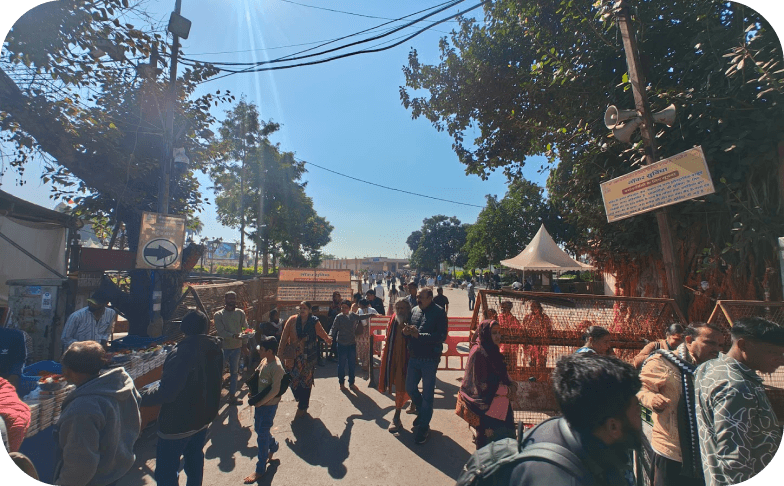
On-ground research kicked off around the Mahakal complex. Following the natural visitor path through Neelkanth Path, the narrow gullies, and the bustling market near Gate 1

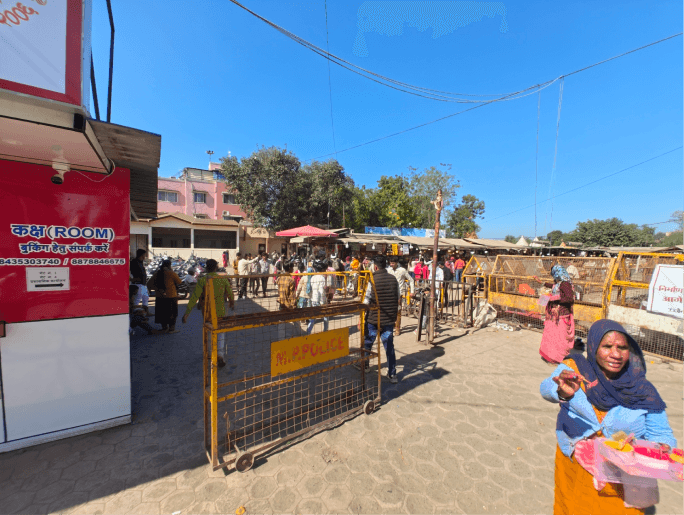
Six interviews on Day 1 — a security guard, an outstation visitor, an elderly fast-track devotee, and general-queue devotees at Gate 1.
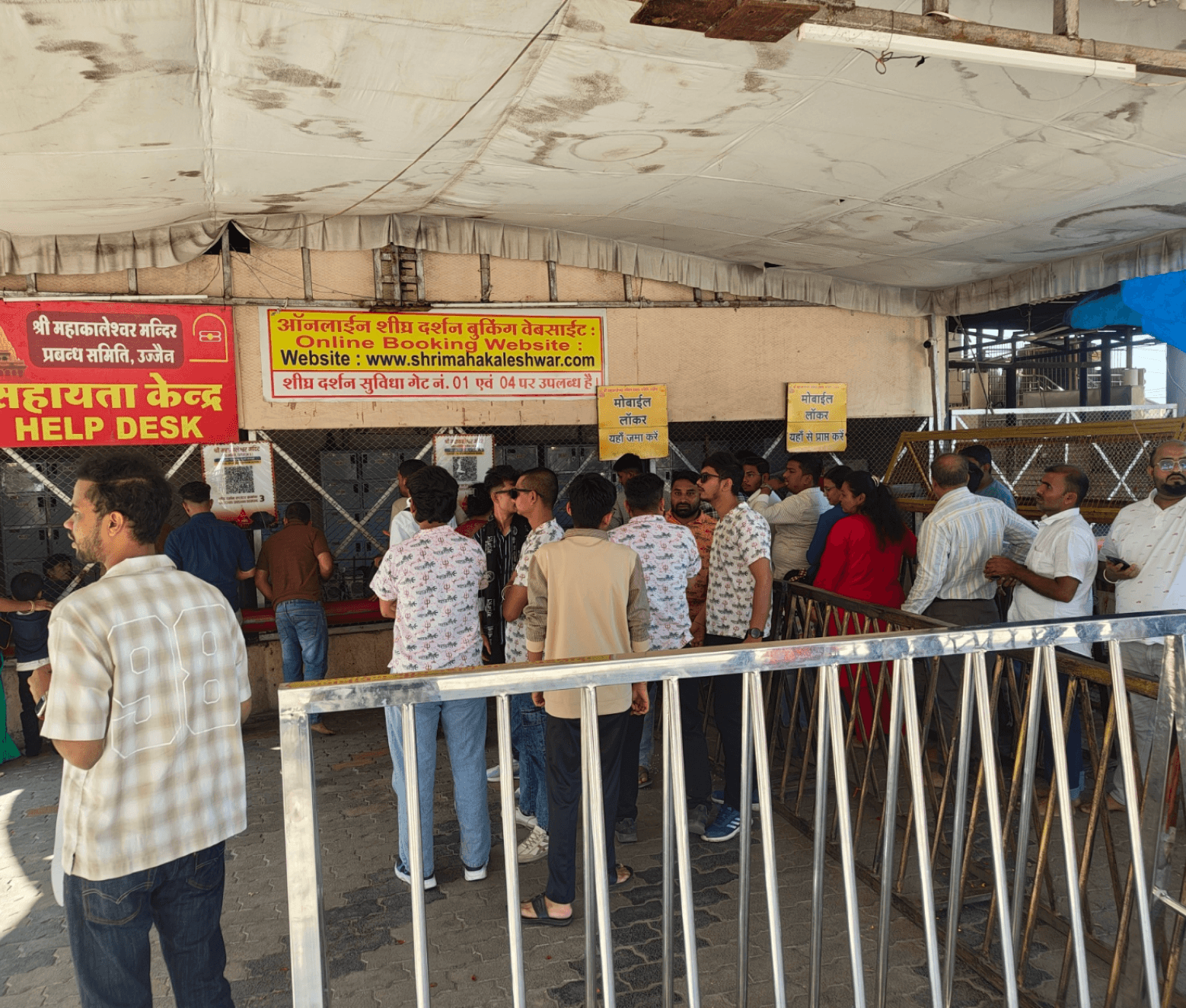
Fly-on-the-wall · Gate 1 phone deposit
Avg wait time: 14 minutes
Deposit handling: 30 - 40 sec (2 phones) to 1 - 1.5 min (4+ phones)
Devotees frequently entered the wrong line (receiver vs depositor)
Visible frustration when deposit took longer, worsened by tight barricades
"Isske bhi 3 counter hone chahiye the general jaise" — a frustrated devotee
from general gate
Shifting gates, experiencing the queue first-hand
I stepped into the queues myself, experiencing general lines firsthand rather than just watching from the sidelines. Moving the research to Gate 10 and the Mansarovar complex, I followed up with three in-depth interviews and extended observation sessions.


Fly-on-the-wall · Mansarovar gate
Avg wait time: 15 minutes
3 deposit + 3 retrieval counters, yet congestion persisted
People squeezed through gaps, creating parallel micro-queues
Devotees caught sneaking phones past security into darshan
"Pankha chalu kardo garmi ho rahi he kaffi" — a frustrated devotee
Checking my work
Does a totally different group see the same thing?
I ran an 11-response survey with local students and residents to cross-validate my field observations. Seeing the exact same friction points confirmed that the issues I documented weren't isolated to my visit.
91%
experienced the queue stop at least once
82%
waited more than 5 min just for phone deposit
64%
took more than 30 min to complete darshan
100%
of respondents cited crowd pushing as a discomfort
Synthesis
150 sticky notes, a good workout for my back
Using FigJam and physical sticky notes, I mapped every data point from the field. Two structured rounds of affinity clustering streamlined 26 thematic clusters into 17 clear findings, ultimately defining 8 core insights.

FLOW
CORe insight
Security checkpoints create bottlenecks
Mansarovar gate became a convergence point of checking, merging, rerouting.
PHYSICAL / EMOTIONAL
CORe insight
Waiting becomes physically and emotionally stressful
Tight barricades and no exits raised fatigue, anxiety, visible frustration.
ROOT CAUSE
CORe insight
Queue confusion is structural, not volume-driven
Even moderate crowds felt chaotic due to poor segmentation, no visible bounds.
PLACEMENT
CORe insight
Phone deposit isn't slow; its placement is
The task itself was quick; unclear timing and location caused the delay.
COMMUNICATION
CORe insight
Inconsistent communication breaks compliance
Devotees deposited phones only when explicitly instructed; not by default.
GUIDANCE
supporting
In absence of guidance, devotees follow the crowd
Without signage, crowd behavior became the default navigation system.
DEPENDENCY
supporting
Queue movement is staff-dependent
Lines advanced mainly when staff intervened, not on their own structure.
EXPECTATION
supporting
Waiting is accepted, uncertainty is not
Devotees were ready to wait; stress rose only when duration was unclear.
The reasoning layer
Where I was wrong, and where the field proved me right
The fieldwork challenged several assumptions. One hypothesis was flatly disproven: the phone deposit process itself wasn't slow, the bottleneck was happening upstream. Two others had to be reframed once the real patterns emerged, while the remaining six held up, fully or partially.
VALIDATED
Congestion occurs because of queue-space layout creating choke points.
Confirmed directly.
VALIDATED
Staff and security communication styles influence queue flow and clarity.
Confirmed.
VALIDATED
Longer waiting times and unclear queue movement cause physical and emotional stress.
Confirmed.
VALIDATED
Operational processes like token handling and staff coordination aren't optimized for crowd volume.
Confirmed.
REJECTED
Phone deposit queues take long because of the digital process it takes to deposit the phone.
Phone deposit itself doesn't take long, handling was 30 sec to 1.5 min. The delay is elsewhere.
REFRAMED
People don't know about alternative phone deposit queues due to lack of navigation.
The real issue: the deposit line becomes a bottleneck due to poor exit design and crowd overlap, not awareness of alternatives. (Insight 6)
REFRAMED
Devotees are unclear about the phone-deposit process, causing them to join the wrong queue.
Lack of clear wayfinding causes devotees to rely on crowd behaviour, leading to incorrect queue choice. (Insight 3)
PARTIALLY VALIDATED
Inefficiency in the phone-deposit line directly delays other queues and total darshan time.
The deposit itself was fast, but the waiting time around it was much more than expected.
PARTIALLY VALIDATED
Devotees are unaware of alternative queue options, causing overcrowding in one queue.
Most were actually aware of alternatives (like fast-track) but chose the free general option anyway.
Who the queue fails differently
Two people, two very different queues
While one persona accepts the wait as part of the ritual and the other paid to skip it, both hit the same structural bottlenecks. The core breakdowns remain identical, only the perceived frustration changes.

Rajesh, 42
General queue · Frequent visitor
Time-pressured
Family group
Queue-anxious
Visits Mahakaleshwar from outside Ujjain with family, focused on a smooth darshan but repeatedly thrown off by unpredictable waits and shifting queue rules.
"We waited 30 minutes just to deposit our phone."

Devang, 58
Fast-track darshan · Frequent visitor
Efficiency-first
Repeat visitor
Expects visible speed
A regular visitor who pays for Shighra Darshan specifically to save time — and expects that payment to translate into a visibly faster, more organized experience.
"Thoda jaldi hai humko isliye ticket karwaye."
Prioritizing what to fix
Pre-entry phone deposit clarity
High
DECIDING FACTOR: FEASIBILITY
Prioritized quick-win signage and enforcement over a heavy rebuild to build fast.
Queue flow & choke-point mgmt
High
DECIDING FACTOR: VIABILITY
Only medium feasibility, but the reduction in devotee stress and the fix to Shighra/general merging was too large to deprioritize.
Predictability of wait time
Mid
DECIDING FACTOR: DESIRABILITY
The survey showed devotees wanted predictability even more than speed.
Info before queue commitment
Mid
DECIDING FACTOR: DESIRABILITY
Devotees consistently asked for information before committing to a line, not just a faster one.
Recommendations
Four changes, taken forward
01
fix now
Clear, informed darshan choices
Marked phone-deposit checkpoints before the queue, cutting violations and rerouting at entry.
Less enforcement friction
Informed choice
Measure: % of devotees depositing before reaching security, vs. redirected at the gate
02
fix soon
Reconfigured queue paths
Barriers and visual cues to stop unauthorized switching, keeping general and paid channels fair.
Fair access
Smoother flow
Measure: unauthorized queue-switch incidents observed per hour
03
fix soon
Real wait-time communication
Approximate wait time displayed so devotees can set expectations and prepare mentally.
Predictable wait
Balanced usage
Measure: gap between expected vs. actual wait, self-reported
04
fix later
Dedicated exit routing
Separated exit paths and signage to avoid cross-flow with incoming devotees.
Better flow
Lower enforcement load
Measure: cross-flow incidents at the merge point per hour
What it could look like, shipped
If this were actually built
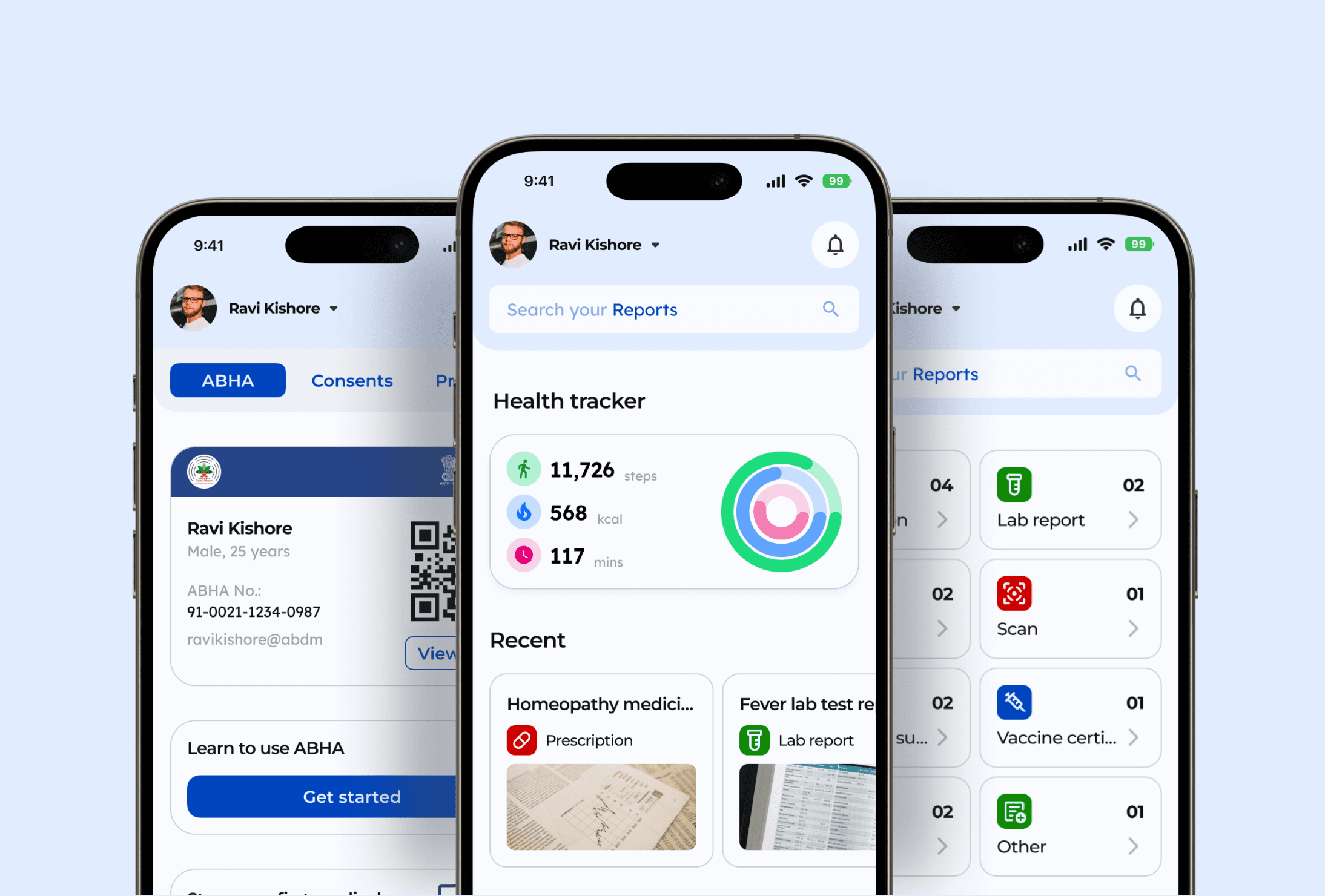
This was an exploratory UX research project focused on problem discovery and concept validation. The proposed solutions and mockups are exploratory design concepts and were not deployed on-ground.

What improves
Fewer last-minute conflicts
Early info lets devotees pick the right queue upfront.
Lower anxiety
Visible wait time reduces impatience and uncertainty.
Smoother operations
Less staff intervention needed to keep lines moving.
Fairer access
Clearer enforcement reduces queue-jumping and switching.
See more projects